
Trailer Interchange vs. Non-Owned Trailer Coverage for California Truckers
Borrowing, interchanging, or hauling a customer’s trailer? Learn how California carriers can separate trailer damage, cargo, and liability before requesting a quote.
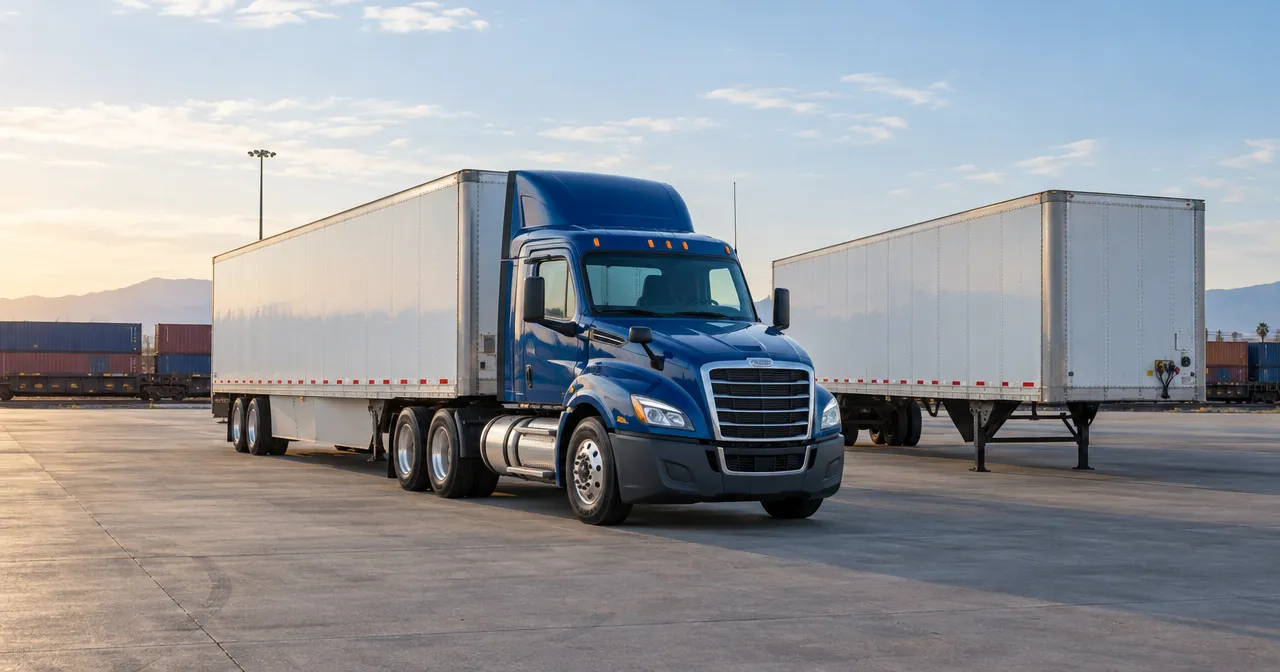
A California carrier may own its tractor but pull three different trailers in one week: its own dry van on Monday, a shipper’s refrigerated trailer on Wednesday, and an intermodal chassis on Friday. The question “Is my trailer covered?” has a different answer for each move. The owner of the equipment, the agreement governing its use, and the policy form all matter.
Trailer interchange insurance is generally about physical damage to someone else’s trailer or intermodal equipment under an interchange arrangement. A carrier that borrows or leases a trailer without a qualifying interchange agreement may need a different non-owned-trailer arrangement. Neither answer is supplied by the tractor’s liability limit or the motor truck cargo limit. This guide helps California owner-operators and fleets sort the questions before taking a load or requesting a commercial truck insurance quote. Policy wording and insurer acceptance—not the shorthand on a dispatch sheet—determine actual coverage.
First separate the tractor, trailer, freight, and agreement
Draw four lines on a piece of paper for the next assignment:
- Power unit: Who owns or leases the tractor, box truck, or hotshot power unit? Which business operates it, and under whose authority?
- Trailer or chassis: Who owns the towed equipment? Is it an owned trailer on your schedule, a borrowed customer trailer, a short-term rental, or equipment received under an interchange agreement?
- Freight: What is inside or on the trailer, and who is responsible for it under the transportation contract?
- Paperwork: What agreement controls possession of the equipment? Who signs it, when does responsibility begin and end, and what insurance must the carrier show?
The distinction matters because repairing a dented tractor, replacing a stolen customer trailer, paying a claim for damaged produce, and responding to another driver’s injury are different losses. A single accident can involve all four. If your company changes equipment arrangements between local California work and regional runs to Arizona or Nevada, repeat this exercise for each arrangement rather than assuming one certificate covers the whole operation.
What trailer interchange insurance is designed to address
An interchange agreement sets terms for one party to use equipment owned by another. In the insurance context, trailer interchange coverage is a way to address physical loss of or damage to non-owned equipment while the carrier has it under the applicable agreement, subject to the policy’s terms. A stolen trailer, collision-damaged chassis, or fire-damaged container may raise a trailer-interchange question. It is not a substitute for insurance on the freight inside.
For a concrete illustration, Progressive Commercial describes its trailer interchange coverage as physical damage protection for a non-owned trailer pulled under a written trailer interchange agreement. Its explanation lists a separate limit and deductible and says the equipment must be in the insured’s possession under that written agreement. Those are terms of Progressive’s described product, not a promise that every carrier or insurer uses identical wording. Ask the agent to identify the exact triggering agreement, covered equipment, custody period, causes of loss, and any requirements in the proposed form.
Do not confuse this with physical damage on an owned tractor or trailer. Progressive’s physical-damage explanation explicitly distinguishes its vehicle physical-damage coverage from its separate trailer-interchange protection for non-owned trailers. Other insurers may organize their forms differently. The operational question remains the same: Which policy provision, if any, pays for damage to this particular piece of equipment?
When “non-owned trailer” is the more useful question
Not every trailer someone else owns comes to you through a written interchange agreement. A California fleet might borrow a shipper’s dry van for a single delivery, rent a flatbed for a project, or pull a customer-owned reefer under a service contract that does not clearly function as an interchange agreement. The operator may still owe the owner for damage, but it should not assume an interchange endorsement applies automatically.
Ask your agent whether a non-owned-trailer physical-damage option is available for that exact arrangement, or whether a different policy form or change to the agreement is needed. Product labels can sound similar while eligibility, covered causes of loss, and possession terms differ. A quote that says “trailer interchange” does not prove it responds to every borrowed trailer; a quote that says “non-owned trailer” does not prove it meets a terminal’s interchange rules. Bring the contract, not just a summary of what the broker said.
For each borrowed or leased unit, record who has possession while it is parked, loaded, being repaired, or awaiting return. Ask when responsibility transfers back to the owner. The answers can expose gaps between the commercial arrangement and the insurer’s definition of covered equipment. They also matter when dispatch swaps trailers at a yard without telling the office.
Do not let the word “trailer” hide three other coverages
Primary commercial auto liability addresses covered claims for injury or property damage to others arising from use of covered autos. It is not, by itself, a promise to replace the trailer your carrier has borrowed. Review the covered-auto terms, drivers, and liability limits separately from trailer physical damage.
Physical damage for owned equipment concerns the carrier’s tractor and any trailer insured under its own equipment coverage, according to the policy’s vehicle schedule, coverage selections, valuation, and deductibles. If you sell an owned trailer and start pulling a shipper’s unit, the old trailer listing is not a reliable answer to the new non-owned equipment exposure.
Motor truck cargo concerns the freight being transported, not the value of the trailer carrying it. Progressive Commercial’s cargo overview distinguishes cargo from the vehicle and describes separate limits, deductibles, and restrictions. A reefer load adds another practical question: are temperature-related loss or refrigeration breakdown covered under the actual cargo form, and on what conditions? Equipment and freight can be damaged in the same incident but fall under different provisions.
Trailer interchange or other non-owned-trailer physical damage concerns the non-owned equipment itself, when its form’s requirements are met. It may be affected by the contract, the type of trailer or chassis, where and how it is used, and the insurer’s definitions. Make the agent answer each of these four coverage questions separately rather than accepting “full coverage” as an answer.
Size the limit and deductible to the equipment—not the freight
A useful comparison starts with the highest-value non-owned equipment you will have in your care at one time, plus any contractually required limit. If one fleet alternates between older dry vans and newer refrigerated trailers, a figure based on the dry van alone could be inadequate for a reefer. If it may hold two customer trailers at once—one parked and one moving—ask whether the form limits payment per trailer, per loss, or in the aggregate. Do not infer the answer from a certificate line that shows one round number.
Consider a fictional example: a carrier accepts responsibility for a trailer with an estimated value of $60,000 but buys a $40,000 trailer-damage limit with a $2,500 deductible. If that trailer is stolen, the $40,000 limit cannot become $60,000 simply because the equipment owner has an invoice for the higher amount. The deductible, valuation terms, exclusions, and any contractual obligations can affect what the carrier ultimately pays. This is a comparison exercise, not a claim-payment calculation or a recommendation for a particular limit. Ask for a quote at limits that reflect the actual equipment and agreement.
Also compare deductible structures. A lower premium paired with a deductible your business cannot fund may be a poor match for a one-truck operation. Ask whether theft and collision share a deductible, whether special deductibles apply, and whether accessories such as reefer units or chassis components fall within the covered equipment definition. Ask the equipment owner for a realistic value or stated contractual value; do not substitute the freight’s declared value for the trailer’s value.
California intermodal moves require their own check
A carrier pulling equipment at a California port or rail facility may encounter the Uniform Intermodal Interchange and Facilities Access Agreement (UIIA) and equipment-provider requirements. IANA, which administers the program, describes it as an interchange agreement between motor carriers and equipment providers. Its UIIA insurance requirements identify auto liability, general liability, and, for many participating equipment providers, cargo and trailer interchange requirements. The page explains that trailer interchange limits and deductibles vary by equipment provider, and that the protection addresses non-owned equipment such as containers, chassis, or trailers while in the carrier’s care, custody, or control.
This is not a rule that every California freight move needs UIIA coverage. A warehouse-to-warehouse delivery under a private trailer rental is a different arrangement. For a port or rail assignment, identify the specific equipment provider and its current requirements, any addendum, the needed insurance forms or endorsements, and how the insurer will document them. IANA’s motor-carrier and insurance-agent FAQ also distinguishes UIIA participation and equipment-provider approval from simply having an insurance certificate. Terminal access, contract participation, and policy coverage should be checked as separate steps.
Do not wait until the morning of a first intermodal pickup to send a general-purpose COI. IANA says participating agents submit insurance through its online system and outlines additional-insured and endorsement information for applicable equipment providers. A certificate can communicate coverage information, but writing a requested phrase on one is not the same as adding an endorsement or changing a policy. Have your agent compare the actual forms and effective dates with the provider’s written instructions.
Three dispatch situations that need different answers
An owner-operator hauling a shipper’s reefer. The California-based tractor is insured, but the customer owns the refrigerated trailer. The contract requires the operator to return the trailer in good condition and to protect temperature-sensitive cargo. Ask whether the trailer arrangement qualifies for the offered interchange form or instead needs a non-owned-trailer option; ask how the reefer unit itself is treated. Separately review cargo terms for the commodity and any refrigeration-related loss. A $100,000 cargo requirement says nothing by itself about the dollar limit available to replace the trailer.
A small fleet using a borrowed flatbed for a short project. A dispatcher in Fresno borrows a flatbed for a regional machinery move, with no clear written interchange agreement. Do not label this “interchange” just because the trailer will be returned. Send the owner’s agreement, expected pickup and return dates, equipment value, routes, and the intended power unit to the agent. If coverage depends on a signed agreement, an insurer endorsement, or a different form, resolve that before moving the trailer. Review cargo terms for machinery separately from damage to the flatbed.
A drayage carrier collecting a chassis and container. The carrier already has commercial auto liability and motor truck cargo, but its new equipment provider asks for specified interchange protection and documentation through the UIIA process. Identify whether the proposed form covers both kinds of equipment, whether its limit and deductible satisfy that provider, and whether all required endorsements have been issued. Confirm provider approval and policy dates; do not treat an email saying “COI requested” as clearance to dispatch.
The first two examples are hypothetical and may have different outcomes with different policy forms. The third describes the kind of comparison a UIIA participant should make, not a claim that any particular carrier is approved.
Questions to ask when comparing trailer coverage quotes
Give your agent these questions with the actual agreement in front of you:
- Trigger: Does the form require a written interchange agreement? Does our rental, borrowing, or shipper contract qualify?
- Equipment: Are dry vans, reefers and their units, flatbeds, containers, chassis, and other units we use eligible? Is each unit required to be scheduled or reported?
- Timing: When does coverage begin and end if the unit is left at a yard, switched to another driver, or returned to an equipment provider?
- Losses: Which physical-damage causes are covered? How are theft, collision, fire, and vandalism treated, and what exclusions or special conditions apply?
- Money: Is the limit per trailer, per occurrence, or otherwise structured? What valuation applies? Which deductibles and any sublimits apply?
- Contracts: Does the policy satisfy the specific broker, shipper, lessor, or intermodal provider language? Are additional-insured or other requested endorsements available and actually issued where needed?
- Changes: What should dispatch do before using a new equipment provider, starting a different lane, or keeping more non-owned trailers at the yard?
Ask for the policy provision or written insurer confirmation behind an answer that affects your next dispatch. An agent can explain what a proposed policy says, but a certificate and a quote are not substitutes for the issued coverage and applicable contract.
Send a quote packet that matches the work you do
For a new venture, owner-operator, or established fleet, include the legal business name and operating authority details when relevant; tractor and owned-trailer schedules; drivers; typical commodities; local, regional, or over-the-road routes; and the states where you operate. California may be home base while the trailer moves through Arizona, Nevada, Texas, Colorado, or Oregon—make that clear. Include garaging locations and the number of non-owned units that may be in your possession simultaneously.
For the trailer question specifically, attach the interchange agreement, rental or borrowing terms, shipper contract, equipment-provider instructions, and any COI request. List each equipment type, estimated value, expected pickup and return pattern, and the first date you need coverage. If a refrigerated unit or intermodal chassis is involved, say so. If you already have a policy, send its declarations and trailer-related endorsements for comparison; if you are starting a new authority, say that rather than assuming an existing fleet form will apply.
Lucila’s Insurance Services reviews trucking operations in California and its other service states, including primary commercial auto liability, cargo, physical damage, trailer interchange, and non-owned-trailer coverage. Its English/Spanish team can help organize equipment, contract, certificate, policy-change, and renewal questions. Availability and exact protection depend on the insurer, policy wording, and your operation. For a commercial trucking insurance review, bring the agreement and equipment details to a quote request before you take possession of the next trailer.